“Music is a universal language. It can transport us; help us relive special moments; make us healthier, happier and more connected as family, friends, and as part of a larger community.”
– Concord Conservatory of Music
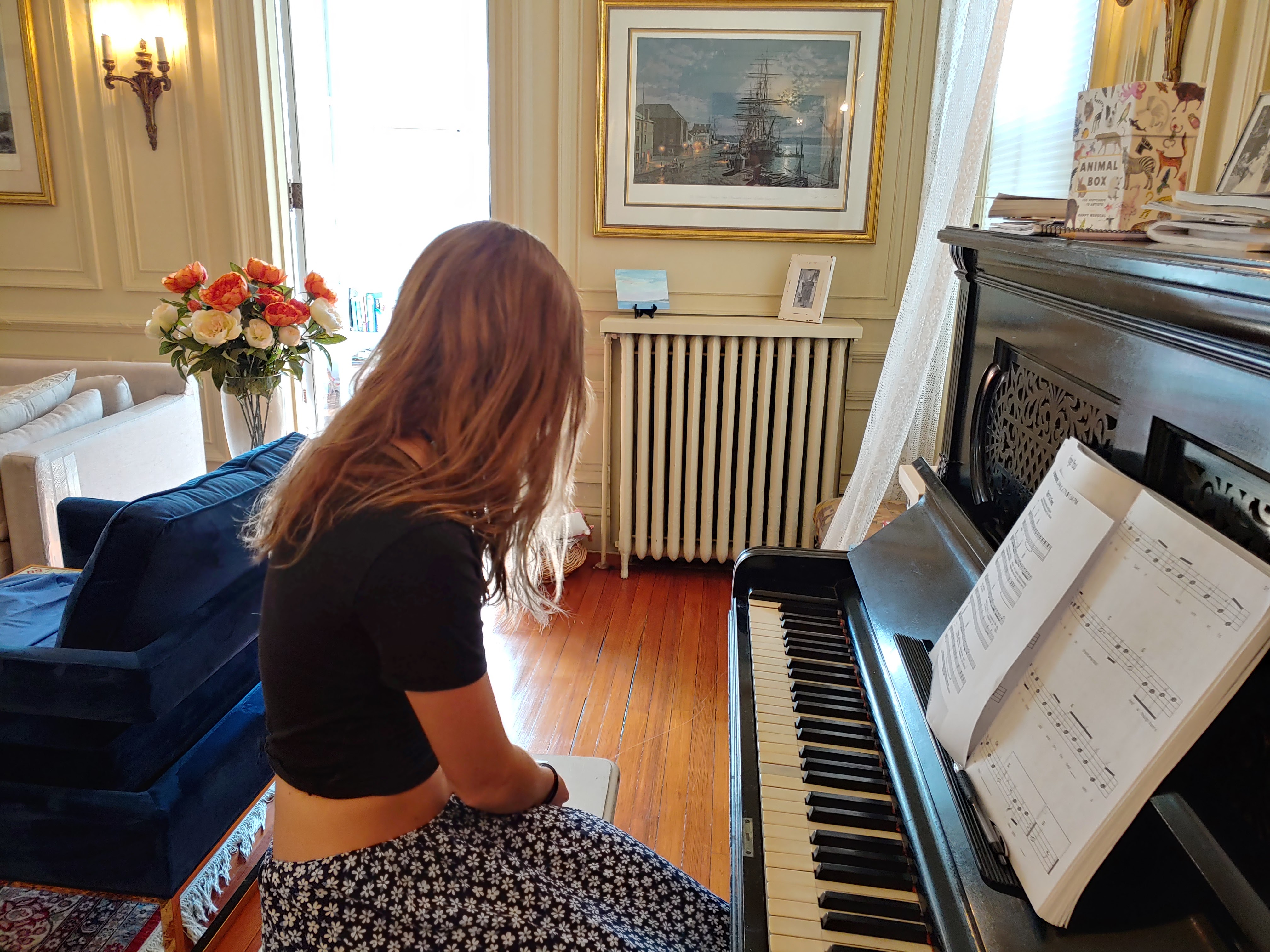
The benefits of playing a musical instrument are well-documented and vast. Our children are piano players. Playing a musical instrument, among many other qualities, aids in developing spatial reasoning, hand-eye coordination, and fine motor control. Oliver realized early on that piano playing was strengthening his hands, increasing his dexterity for baseball pitching. The benefits are infinite.
In addition to the delicate sounds of daily piano practice, I often play soft background music during our homeschool days. It is deeply calming and soothing to have a light melody playing while we work. Spotify has some playlists I like called “Piano for Studying” and “Focus Piano,” which are my usual go-to collections. They are gentle and non-competing as we read, compute, write, and study throughout the day.
Music can reach into our hearts and make us better. Music can change our moods, sharpen our thoughts, and inspire our actions.
Playing background music during school has always appealed to me, although it never occurred to me that there was a beneficial science behind it. Apparently, the right tunes can help us learn. According to writer Sharlene Habermeyer’s recent article Music to Learn By, not all music has this effect. “Only certain classical music builds a bigger, better brain,” she tells us, and “listening to jazz or pop doesn’t have the same beneficial effects.” From experience, this I know to be true. The wrong sounds are distracting during school, and we can listen to the right music all day. How does this work?
“A study conducted by Donald Shetler, Ed.D., of the Eastman School of Music, found that kids who listened to classical music for 20 minutes a day had improved speech and language skills, a stronger memory, and greater organization of the brain.”
I am always amazed, yet never surprised when art and science go hand in hand. One of my favorite books on the beautiful marriage of art and science is Proust was a Neuroscientist by Jonah Lehrer. I love this book and how Lehrer frames the connection between what artists, writers, painters, musicians, and even chefs realized through their craft and how science, often decades later, finally supports these intuitions as fact.

So, certain music can make a difference in our learning. We are now listening to Les Années Folles by Armando Bauer, and my writer’s soul is content. Our home is peaceful, all are focused, and I am certain the connection is real.
Below is a list of music that was tested by Dr. Georgi Lozanov. Known as ‘the father of accelerated learning,’ Lozanov was a Bulgarian neurologist and psychologist passionate about understanding how human beings learn. Among other methodologies, he found that certain classical music could help children and adults concentrate and focus better. According to Lozanov, it takes 15-20 minutes of listening for the electromagnetic frequency of the brain to change to a mode suited for learning. Shazam!
“Another study, done by Georgi Lozanov, M.D., showed that some classical music pieces change the electromagnetic frequency of brain waves to about 7.5 cycles a second. This is called the Alpha Mode, wherein the brain focuses optimally — perfect for studying for a history test or completing a homework assignment.”
His specific suggested list is below: Note: For the full effect, while studying, reading, etc., these pieces should be played quietly, as background music.
Johann Sebastian Bach
Brandenburg Concertos
Fantasia for Organ in G Major
Fantasia in C Minor
Prelude and Fugue in G Major
Ludwig van Beethoven
“Emperor” Concerto for Piano, No. 5
Antonio Vivaldi
The Four Seasons
Johannes Brahms
Concerto for Violin, D Major, Op. 77
Arcangelo Corelli
Concerto Grossi, Op.6, Nos. 2, 4, 5, 8, 11, and 12
George Frideric Handel
Water Music
Concerto for Organ in B Flat Major, Op. 6, 7
Joseph Haydn
Concerto No. 1 for Violin
Concerto No. 2 for Violin
Symphony No. 101 (The Clock)
Symphony No. 94 in G Major
Wolfgang Amadeus Mozart
Concerto for Violin No. 5 in A Major
Symphony No. 29 in A Major
Symphony No. 40 in G Minor
Symphony No. 35 in D Major
A Little Night Music
Peter Ilyich Tchaikovsky
Concerto for Violin, Op. 35
Concerto for Piano, No. 1
Brilliant.
—-
Sources:
Sharlene Habermeyer, M.A. /(Verified) Updated on October 20, 2022; ADDitude Magazine
Spotify
http://www.learningdoorway.com/georgi-lozanov
For more music and Learning for all ages, read here: https://www.learningdoorway.com/music-and-learning.html
Eastman School of Music: https://www.urmc.rochester.edu/
©2022 Lynne Rey
Blog Published by GoTimbalero Press
All rights reserved. No part of this blog or blog post may be used or reproduced in any manner whatsoever without written permission, except in the case of brief quotations. This is a narrative work; names, characters, places, and incidents are based on the author’s memory and written from the author’s perspective.
Photos are the property of the Rey family archive. For information or permission, address GoTimbalero Press, P.O. Box 247, Newport, RI 02840
Editing and Design by Lynne Rey

 T I M B A L E R O
Love this piece on music. Many many years ago our father insisted that his six children play a musical instrument. I played the trumpet for 8 years and even won some state contest. I tried piano but with not having one at home it was an impossible task.
Today I love to listen to music and dance to music. It brings a calmness within me.
Thanks Lynne for this piece on what music brings into one’s life.. love mom
LikeLiked by 1 person
This is so great. Your parents knew the importance of music! (I grew up without a piano in the house, too. So sad for us both! 😉)
LikeLike
Our mother was a great lover of music and sang to us all the time! Encouraged us to take part in school functions, school choir, band etc!
LikeLike
Yes, she was! She taught me the very best songs I will never forget!
LikeLike
Our home had much music (though not classical); always a piano. Mom was a music major and teacher. Dad was self-taught on guitar/banjo/ukulele/harmonica. They both sang. I took many lessons, but never tried hard enough to excel. Nor did we push our kids to play. Much to my regret. This is all great to know, and our granddaughter will have these benefits.
LikeLike
I did not know this! Did Debbie take lessons too? There is an old-worldness that seems to linger around piano-playing and certainly mandatory lessons, but I am so glad we took it on. Even through the covid years, our piano teacher gave online lessons and they were totally effective; the kids never missed a beat (punny!) Marilyn, its never too late to start!
LikeLike
I took lessons on accordion (when I was too small to hold it well), flute (played in the band a while), piano and a little guitar. Never got good at any of them. Debbie never took any music lessons at all. She was #4 and mom gave up. My oldest sister played saxophone in band and piano (still plays). The next one played clarinet in band, but no piano.
LikeLike
❤️❤️❤️
LikeLike